Quick Information
Is Karnak Temple worth visiting?
Stone, sunlight, and sheer scale hit first. You pass between ram-headed sphinxes, step through the pylon, and suddenly the columns of the Great Hypostyle Hall rise around you like a carved forest. Even on a busy day, Karnak feels bigger than the crowd, with open courts, shattered walls, and flashes of surviving color overhead.
Karnak was built as the ceremonial heart of ancient Thebes, a place where pharaohs expanded the temple to honor Amun and advertise their power. That long buildup matters because you’re not seeing one monument, but centuries of ambition layered in stone.
The payoff is physical: you leave with a sense of how enormous ancient Egyptian religion and statecraft once felt at ground level. Few places let you move through history at this scale rather than just look at it from a distance.
Skip it if intense heat, long walks on uneven ground, or a largely outdoor visit will drain you before the main hall does.
What to see inside Karnak Temple?
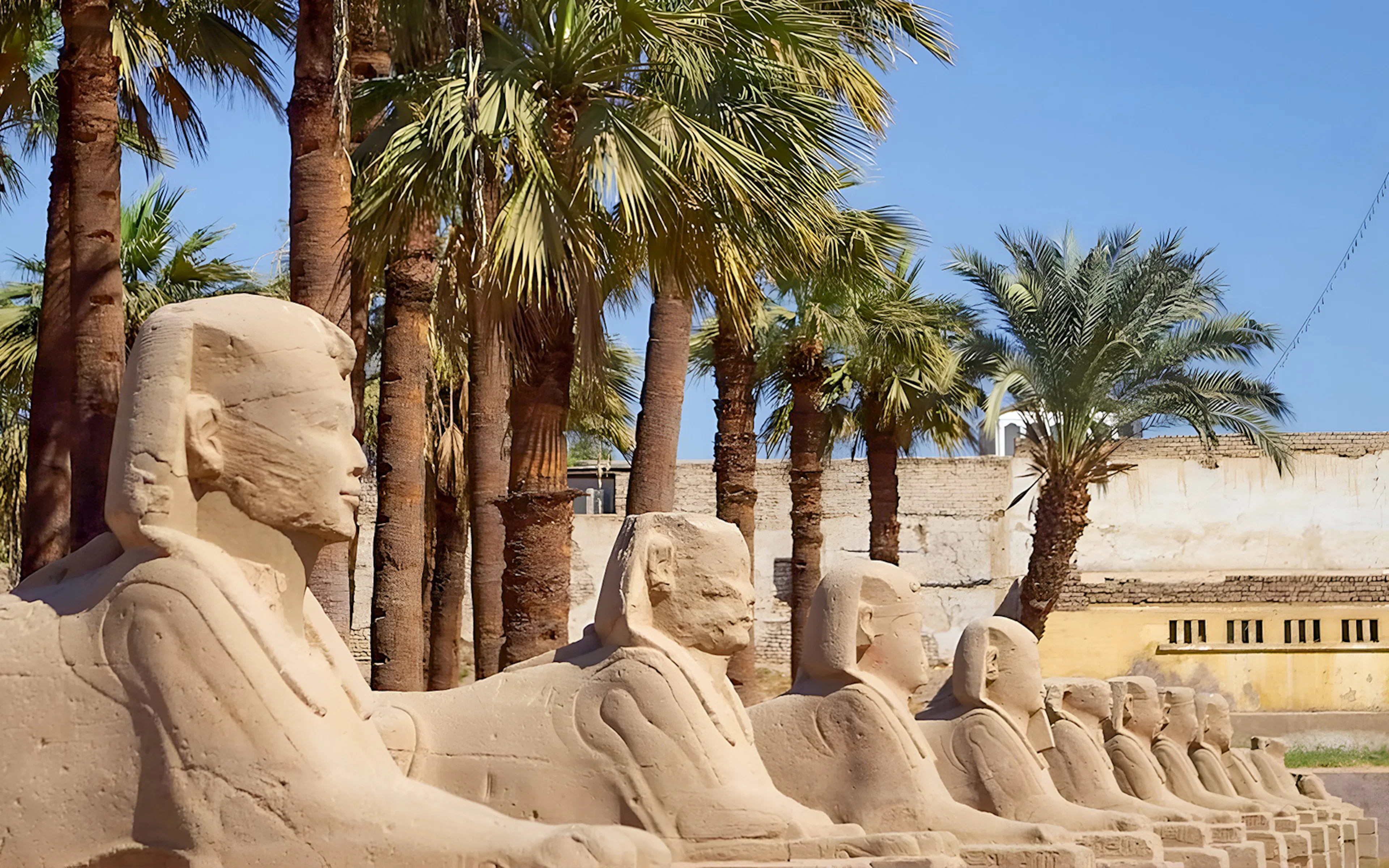
Avenue of ram-headed sphinxes
This ceremonial approach sets the tone before you reach the first pylon. The ram-headed guardians once marked the processional route of Amun and still make the entrance feel deliberately grand.
The Great Courtyard
Immediately beyond the first pylon, this broad court helps you grasp Karnak’s scale. It’s where many guided groups pause first, so move through steadily if you want a quieter start.
The Great Hypostyle Hall
Karnak’s defining space: 134 colossal columns packed closely enough to feel like a stone forest. Come here early if you want clearer photos and a better chance to notice surviving color high above.
Hatshepsut’s obelisk
This soaring granite obelisk still anchors the inner temple area and gives you a direct sense of royal ambition. Stand close to read the inscriptions and appreciate how slender it feels against the surrounding masonry.
The Sacred Lake
A calmer stop after the central axis, this ritual basin opens the site visually and offers a breather from the densest crowds. It also helps explain Karnak as a working religious complex, not just a monumental facade.
Festival Hall of Thutmose III
Deeper inside the complex, this hall rewards visitors who keep going past the obvious highlights. Its more intricate spaces and reliefs feel quieter, older, and noticeably less tour-bus dominated.
Temple of Khonsu
Often missed on rushed visits, this smaller temple near the south-west side feels more intact and more intimate than Karnak’s grand courts. It’s a smart final stop before heading back toward the exit.
How to explore Karnak Temple
How much time to spend?
Budget 2–3 hours for Karnak alone if you’re exploring at your own pace, or around 90 minutes on site if it’s part of a combined guided outing. Give yourself longer if you want time for photography, quieter side spaces, or the Temple of Khonsu.
Best visit order
Enter through the main east-side gate and head straight from the Great Courtyard into the Great Hypostyle Hall before guided groups thicken. Continue along the central axis to the obelisks and inner courts, then peel south to the Sacred Lake. Finish with the Temple of Khonsu on your way back toward the exit.
Must-see highlights
Must-see: the Avenue of ram-headed sphinxes, the Great Hypostyle Hall, Hatshepsut’s obelisk, and the Sacred Lake. Optional: the Festival Hall of Thutmose III and the Temple of Khonsu, which add about 30–45 minutes and reward visitors who want calmer corners.
Worth adding nearby
Luxor Temple is the natural add-on and works well in the same half-day; it adds about 1–1.5 hours and gives you the riverside counterpart to Karnak’s vast scale. If you have a full day, pair Karnak with the Valley of the Kings and Hatshepsut Temple on the West Bank.
Guided or self-paced?
A guided visit is worth it if you want the carvings, dynasties, and ritual layout explained clearly; Karnak can feel visually overwhelming without context. Self-paced works if you mainly want time for photography and already know the main route. The most balanced guided option is Half-Day Luxor East Bank Tour: Karnak Temple & Luxor Temple with Tickets, Transfers and Optional Lunch. For an independent visit, Karnak Temple Skip-the-Line Entry Tickets keep the visit flexible, and the audio guide option adds useful background.
Brief history of Karnak Temple
- Middle Kingdom: Karnak emerges as Ipet-isut, the sacred precinct of Amun and an increasingly important religious center in Thebes.
- 18th Dynasty: Hatshepsut and Thutmose III expand the complex with obelisks, chapels, and festival spaces as Thebes rises to imperial power.
- 19th Dynasty: Seti I and Ramesses II build much of the Great Hypostyle Hall, the columned heart of today’s visitor route.
- Late Period to Ptolemaic era: Successive rulers continue adding pylons, courts, and shrines, turning Karnak into a layered religious city.
- 19th and 20th centuries: Excavation and restoration clear buried sections, re-erect fallen blocks, and begin long-term conservation across the precinct.
- Today: Karnak stands within UNESCO-listed Ancient Thebes and remains Luxor’s defining temple complex.
Architecture & design of Karnak Temple
Karnak doesn’t read as one neatly planned building; it feels like a sacred city assembled over centuries, with each court opening into another burst of scale. The architecture is pure procession: ram-headed sphinxes draw you inward, pylons frame the sky like stone gates, and the Great Hypostyle Hall compresses space into a dense forest of columns. Look closely and the surfaces still carry carved hieroglyphs, battle scenes, and traces of original pigment under protected ledges. The engineering feat here is cumulative monumentality rather than a single showpiece—axial planning, colossal masonry, and layered sightlines keep pulling you deeper toward the sanctuary. Even the open courts are designed to shift you from public spectacle toward something more sacred and controlled.
Who built it?
Karnak was commissioned and enlarged by many rulers rather than one architect. Senusret I helped establish the early precinct, while Hatshepsut, Thutmose III, Seti I, and Ramesses II gave the complex much of its present form. It was built to honor Amun and to broadcast royal legitimacy in Thebes.
Why Karnak was the ceremonial heart of Luxor
Karnak was not designed as an isolated monument; it worked as the ceremonial starting point of the Opet Festival, when the divine barques of Amun, Mut, and Khonsu traveled from Karnak to Luxor Temple. That connection explains why the site feels so processional, from sphinx-lined approaches to sequential courts and gateways. For ancient Thebes, Karnak was where theology, kingship, and public ceremony met. When you walk its main axis today, you’re following a route built not just for worship, but for spectacle visible to an entire city.
Frequently asked questions about Karnak Temple
No. It usually only saves the ticket-office step. Everyone still passes through the same bag and security screening at the main entrance, so arriving early remains the best way to reduce waiting and enter before larger tour groups.
Yes. The nighttime show is a separate experience with its own admission and does not replace regular daytime access. Book it as an add-on if you want Karnak’s illuminated atmosphere after seeing the site properly in daylight.
Yes, if the weather is mild and you’re comfortable on city streets. The two temples are only a few kilometers apart, but most visitors still take a short taxi ride to avoid heat and save energy for the ruins themselves.
Yes. Carry a passport or government-issued ID, especially if you booked online or are joining a guided tour. Staff may ask for identification at entry, and it’s much easier to have it ready than sort it out on-site.
No, not inside the temple interiors. Follow posted rules and staff instructions throughout the site; flash, laser pointers, and bulky gear are poor bets, and restrictions are typically enforced more tightly during the Sound & Light Show.
Partly accessible. The main entrance and principal courts are flatter than the deeper side areas, but rough stone, long distances, and limited seating make a full circuit difficult. Visitors with reduced mobility usually do better with a flexible private tour.
Daytime is the essential visit because you can properly see the carvings, columns, and scale of the complex. The night show is atmospheric, but it works best as a second experience, not as your only way of seeing Karnak.


