luxor tours

Guide to planning your Luxor day trip

Luxor works well as a day trip, but only if you match the route to your energy budget. From a Luxor hotel, a bank-specific tour usually takes about 5–7 hours, and a full East and West Bank sweep about 8 hours. From Hurghada, the same highlight loop stretches to roughly 14 hours, while Cairo by plane is a 15–16 hour experience. Decide first whether you want full coverage, or enough time to properly absorb 1 bank.

Quick facts

  • Travel time: About 5–7 hours for a bank-specific tour from Luxor, about 8 hours for a full East and West Bank day, and about 14 hours from Hurghada; Cairo by plane is a full-day trip that takes around 15–16 hours.
  • Time on the ground: Luxor-origin tours give you the most usable monument time; Hurghada and Cairo formats trade more of the day for transport.
  • What fits in a day: East Bank fits Karnak Temples and Luxor Temple; West Bank fits the Valley of the Kings, Temple of Hatshepsut, and Colossi of Memnon; a full day from Luxor fits both banks’ headline stops.
  • What’s included / not: Guide and transfers are standard on current inventory; lunch and entry tickets depend on the option selected. Drinks are commonly extra.
  • Common surprise omission: Tutankhamun’s Tomb is not part of standard Valley of the Kings admission unless your option specifically includes it, or you pay extra onsite.
  • Best way to do it: Full-day from a Luxor hotel (best balance of coverage and fatigue).
  • Should you stay overnight? Smart if you’re coming from Hurghada or Cairo and want less transit fatigue, or evening time at Luxor Temple.

Should you do Luxor as a day trip?

ApproachIs a day trip worth it?What this actually feels likeBetter alternatives

Focused East Bank: Karnak Temples + Luxor Temple

Yes, best way to do it

About 3.5–4 hours from a Luxor hotel, temple-heavy, and easier to pace than a cross-bank day.

Best option if you only have half a day

Focused West Bank: Valley of the Kings + Temple of Hatshepsut + Colossi of Memnon

Yes, if you start early

About 3.5–4 hours, more exposed walking, and the strongest tomb-focused experience in the city.

Better than both banks in extreme heat

Full-day from Luxor hotel: East + West Banks

Yes, best way to do it

About 8 hours, the clearest first-timer overview, but still a scheduled day with limited linger time at each stop.

Best option if you want both banks in 1 day

Hurghada to Luxor same-day

Possible, but rushed

Roughly 14 hours total, so you do cover the icons, but a big share of the day disappears into road time.

Stay overnight in Luxor, or split the banks across 2 days

Cairo to Luxor by plane

Only with a guided tour

It’s feasible because flights, transfers, and entries are bundled, but exact total trip time is around 15–16 hours, and airport handling shapes the day as much as the monuments do.

Overnight in Luxor if you want slower site time

Guided Luxor tour or independent planning?

For most visitors, a guided day trip is the cleaner choice because it removes the hard parts that actually eat time in Luxor: cross-bank transfers, site order, entry handling, and timing between exposed outdoor stops. Independent planning gives you more control, but you’ll still need to manage transport, ticket rules, and heat-sensitive sequencing yourself. If this is your first Luxor day, guided is usually the more efficient format.

How to get to Luxor from your base city

What your Luxor day actually looks like

Hotel pickup for Luxor day trip
1/8

Hotel pickup and route briefing *(If doing a combo.)*

This part feels practical rather than scenic. You’re checking names, sorting seat logistics, and working out whether your day starts on the East Bank or the West Bank. On Hurghada and Cairo formats, this stage matters more because an early delay can ripple through the whole route.

Time needed: 30–60 mins inside a larger transfer block
Local tip: Ask your guide early whether Tutankhamun’s Tomb is included, because it changes both budget and pacing.

Karnak Temples *(Half-day core stop)*

Karnak is the big architecture payoff. You move through pylons, courts, and the Hypostyle Hall, and the scale lands fast, especially once you’re under the column forest. This is usually where a good guide earns their keep, because without context it can blur into stone and heat.

Time needed: About 1.5 hours
Local tip: Don’t burn all your energy on photos at the entrance, the most impressive scale is deeper inside.

Luxor Temple *(Half-day core stop)*

Luxor Temple is more compact and easier to read than Karnak. The site feels tighter, more urban, and less sprawling, which is why it works well on shorter East Bank routes. If your day ends late enough, this is also the most evening-friendly major stop in the core loop.

Time needed: [Information unavailable]
Local tip: If you’re splitting Luxor across 2 sessions, keep Luxor Temple for later in the day and do Karnak earlier.

Lunch and cross-bank transfer *(Full-day only)*

On full-day routes, this is the reset point. You eat, cool off briefly, and then shift mental gears from temple courts to tomb-and-cliff landscapes. If the day is running late, this is often the moment when you feel whether your route still has enough energy for the Valley.

Time needed: 45–90 mins, including transfer
Local tip: Drinks are often extra, so carry cash even when lunch is included.

Valley of the Kings *(Half-day core stop)*

This is the stop most travelers care about most, and the one that suffers fastest from bad timing. You move between the desert valley and tomb interiors, often with short bursts of steep or exposed walking between them. When the route reaches this stop late, people tend to look less, rush more, and feel the heat harder.

Time needed: [Information unavailable]
Local tip: If your product lets you choose or upgrade tomb access, decide before arrival, not at the gate.

Temple of Hatshepsut *(Half-day core stop)*

The shift here is visual. After the Valley’s rock-cut interiors, Hatshepsut opens out into terraces, bright stone, and a cliff-backed façade that looks unlike the rest of the standard circuit. It is usually a shorter stop, but it adds needed contrast to the day.

Time needed: About 45 mins
Local tip: Save a little energy for the wider view back across the forecourt, not just the temple façade close-up.

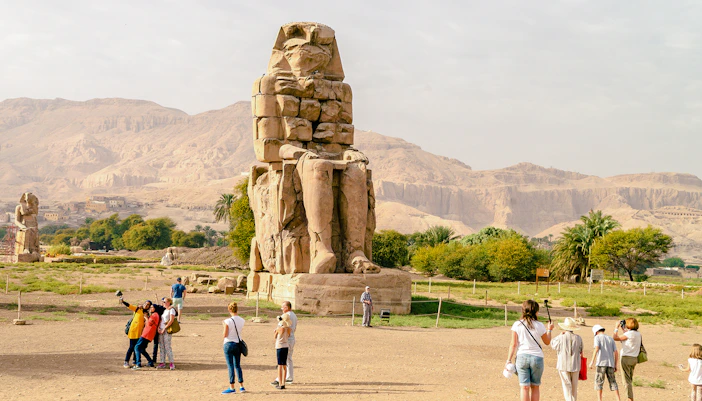
Colossi of Memnon *(If doing a combo.)*

This is usually a short photo stop rather than a deep visit. You pull over, take the classic shot, hear the basic background, and move on. It’s easy to enjoy, but also the easiest part of the standard loop to trim mentally if you’re measuring the day by high-value archaeology.

Time needed: About 30 mins
Local tip: Treat this as a breather stop, not the reason you came to the West Bank.

The long ride or flight home *(Full-day only)*

This final leg is where route choice shows its consequences. From a Luxor hotel, you’ll likely just feel pleasantly tired. From Hurghada, the return can feel much longer than the morning because the monument time is over and the fatigue is already in your legs. From Cairo, the airport process becomes the day’s last fixed constraint.

Time needed: About 14–16 hours total from Hurghada; Cairo total day length [Information unavailable]
Local tip: Keep 1 bottle of water back for the return, not just the sites.

Should you stay overnight in Luxor?

A day trip already works, especially if you’re starting from a Luxor hotel. Overnight changes the experience most for travelers coming from Hurghada or Cairo: you cut the longest transit blocks, make room for a calmer Valley of the Kings visit, and can use Luxor Temple’s later hours instead of racing back the same day.

Luxor-origin day tours in current market research run about US$25–$62 shared, or about US$89–$120 private, while Hurghada day trips sit around US$91–$120. A verified mid-range hotel-and-meal add-on cost is US$50–$80 (ticket cost not included). The trade-off is simple: you spend more, but buy back energy, evening time, and a better shot at seeing the West Bank before fatigue takes over.

Best time for a Luxor day trip

SeasonMonthsWhat it's likeCrowdsBook ahead

Peak

October–March

Best weather for long outdoor monument days, and the easiest season for both-bank touring without summer heat shutting you down.

High

1–2 weeks recommended; 3–4 weeks for Christmas, New Year, and school holiday periods

Shoulder

April–May, September

Still workable for day trips, but the heat starts shaping pace, especially on the West Bank and on full-day loops.

Moderate

3–7 days is usually sufficient; book earlier for weekends and private tours

Off-peak

June–August

Lower demand proxy, but this is the hardest operating window. Mean daily maxima rise to 42.2°C in June, 42.8°C in July, and 42.5°C in August.

Low to moderate

Same-week booking is usually possible; 2–3 days is sufficient for most tours

Best time of day & seasonal insight

Best time of day: Start with the West Bank, especially the Valley of the Kings, as close to opening as your tour allows. That stop loses quality fastest once heat and late-morning crowding build.

💡 Pro tip: If you’re traveling in June, July, or August, reduce route ambition before you reduce price. A shorter bank-specific tour is often the better day.

How to prepare & make the most of your day trip to Luxor

  • Passport or photo ID: Necessary for Cairo flights, and at least some long-haul day trips from Hurghada require a valid passport on travel day.
  • Comfortable walking shoes: West Bank surfaces and temple grounds punish thin sandals fast.
  • Hat, sunglasses, and sunscreen: Shade is limited across the core route.
  • Water bottle: Heat fatigue builds early, especially on full-day or intercity runs.
  • Cash: Useful for drinks, small stop expenses, and premium tomb add-ons.
  • Phone battery pack: Long days plus photos drain phones quickly.
  • Light extra layer: Helpful for pre-dawn pickup, A/C vehicles, or early flights.
  • Not to bring: Large luggage, it slows transfers and is commonly restricted.
  • Pre-book: Entry-included options if you don’t want ticket handling at multiple sites.
  • Check carefully: Lunch is only included on selected variants, and drinks are often extra.
  • Know the tomb rule: Tutankhamun’s Tomb is not standard Valley of the Kings admission unless your option says so.
  • For Cairo by plane: You’ll need to send full traveler names and passport numbers after booking.
  • For Luxor hotel tours: Pickup outside central Luxor may cost extra.
  • Best booking logic: If you care more about pacing than price, private is the useful upgrade, not another minor add-on.
  • Lunch on tour: Useful as a recovery break, but don’t assume drinks are included.
  • Optional shopping stops: Treat them as expendable, not essential. If your priority is archaeology, make sure the core monuments stay central to the day.
  • If you convert to an overnight: Staying in Luxor makes the most sense when you want an earlier West Bank start or time at Luxor Temple after daylight touring.
  • Where to stay: A verified neighborhood-by-neighborhood recommendation is [Information unavailable].
  • What to buy: Monument entry and route quality matter far more than a souvenir stop on a 1-day schedule.
  • Start the Valley of the Kings as early as your route allows, because timing matters more there than at the shorter stops.
  • If you only have half a day, choose 1 bank and commit to it instead of squeezing both.
  • Karnak absorbs more time than first-timers expect, so don’t plan your whole day around the entrance photo.
  • The Colossi of Memnon are easy to enjoy, but they are not the make-or-break stop.
  • On Hurghada routes, save energy for the West Bank, not just the morning departure.
  • If entry is not included, know your onsite ticket plan before pickup.
  • Nobody tells you this: the return leg feels much longer once the archaeology is over, so keep water and a small snack for the ride back.

Getting around once you arrive

When it makes sense: Within a single site, or for a tight East Bank pairing where your transport is already sorted.
Cost: No direct transport cost once you’re there.
Honest note: Luxor is not a compact, walk-everywhere destination. Individual sites can be large, and major attractions are spread across both sides of the Nile. Walking works inside archaeological complexes, but not as a practical way to link multiple attractions during a day trip.

When it makes sense: For simple local journeys if you're staying in Luxor and have a flexible schedule.
Cost: Approximately EGP 5–20 (US$0.10–0.40) per journey.
Honest note: Public transport is not the easiest way to build a sightseeing itinerary around timed monument visits. Services may not align neatly with opening hours, and reaching multiple East Bank and West Bank attractions in a single day can be time-consuming.

When it makes sense: For direct journeys between your hotel, ferry points, and major attractions, or when building your own self-guided itinerary.
Cost: Approximately EGP 100–300 (US$2–6) for most in-city journeys; longer cross-bank routes may cost more depending on distance and negotiation.
Honest note: Taxis are widely used by visitors, but you'll need to factor in waiting time, return journeys, and multiple stops. App-based ride availability can vary, particularly away from central tourist areas, so it's worth arranging return transport in advance.

When it makes sense: Only if you already know Luxor well, are staying longer, and want to build your own route outside a fixed tour.
Cost: Approximately EGP 1,000–2,500+** (US$20–50+) per day for rental, excluding fuel and any optional insurance.
Honest note:** You gain freedom, but lose the day-trip advantages most visitors actually need: cross-bank coordination, site order, and not having to think about parking or timing in the heat.

✨ What guided tours handle automatically On a good Luxor day trip, the invisible work is what helps most: cross-bank transfers, hotel pickup, route order, entry handling where included, and getting you back without negotiating every connection yourself. DIY can work, but it asks you to manage the day’s weakest points instead of just the monuments.

✨ What guided tours handle automatically

On a good Luxor day trip, the invisible work is what helps most: cross-bank transfers, hotel pickup, route order, entry handling where included, and getting you back without negotiating every connection yourself. DIY can work, but it asks you to manage the day’s weakest points instead of just the monuments.

Frequently asked questions

Yes, if you plan honestly. From a Luxor hotel, 1 bank usually works well in about 5–7 hours, and both banks can be covered in about 8 hours. The compromise is depth: a full highlights day gives you the icons, not long, slow site time.